
Orcas are a fundamental part of the vast marine ecosystem that inhabits the Sea of Cortez and the Pacific Ocean. This species, known as Orcinus orca (Linnaeus, 1758), spans extensive marine territories worldwide and has one of the widest geographic distributions in the animal kingdom, inhabiting virtually all seas. However, they tend to concentrate in temperate and cold coastal areas, where marine life is more abundant. They are common along the Pacific coast of North America, Canada, Iceland, and Norway, and can be found in both the Arctic and Antarctic. Visitors staying in Cabo San Lucas vacation villa rentals often choose the region to experience its incredible biodiversity and marine encounters, making Baja California Sur a world-renowned destination.
In the Sea of Cortez, orcas play a key role in the marine ecological balance. As apex predators, they help maintain healthy populations of other species and reflect the ecosystem’s conservation status. Their presence also indicates the biodiversity and natural wealth that characterize this region, known as “The Aquarium of the World.” Many luxury Lifestyle villas located within exclusive communities in Cabo San Lucas provide travelers with access to unforgettable whale watching and eco-tourism experiences across the Sea of Cortez.
Their anatomy is among the most recognizable worldwide. They have a black dorsal coloration and a white belly that extends from the tip of the jaw to the urogenital region. The sexes of orcas can be distinguished by observation. In males, the white area is more elongated, whereas in females, there are two dark patches on each side of the genital opening, corresponding to the mammary glands.
Threats Facing Orcas and the Importance of Conservation
An important point to highlight is the danger that orcas, as well as many other marine species, face, as they are exposed to threats stemming primarily from human activity. Many actions can help reduce the negative impact on the environment where orcas live, but to do so, it is essential to understand the main threats. According to the National Oceanic and Atmospheric Administration (NOAA), the most concerning are:
- Entanglement and collisions with fishing gear.
- Marine pollution, especially from persistent organic pollutants.
- Noise pollution generated by human activities such as maritime traffic or seismic exploration.
- Oil spills.
- Habitat loss and degradation.
- Decreased prey availability as a result of overfishing and climate change.
The conservation of orcas and all marine species is fundamental to the future of the oceans. Protecting them also means protecting the balance of the seas, and this certainly applies to our Sea of Cortez, a prime location in Baja California Sur for whale watching, since the health of its ecosystems and human activities depend directly on the sea. Education, responsible tourism, scientific research, and good environmental practices are key tools for achieving a healthy and sustainable coexistence between people and marine life.
Threats Facing Orcas and the Importance of Conservation
An important point to highlight is the danger that orcas, as well as many other marine species, face, as they are exposed to threats stemming primarily from human activity. Many actions can help reduce the negative impact on the environment where orcas live, but to do so, it is essential to understand the main threats. According to the National Oceanic and Atmospheric Administration (NOAA), the most concerning are:
- Entanglement and collisions with fishing gear.
- Marine pollution, especially from persistent organic pollutants.
- Noise pollution generated by human activities such as maritime traffic or seismic exploration.
- Oil spills.
- Habitat loss and degradation.
- Decreased prey availability as a result of overfishing and climate change.
The conservation of orcas and all marine species is fundamental to the future of the oceans. Protecting them also means protecting the balance of the seas, and this certainly applies to our Sea of Cortez, a prime location in Baja California Sur for whale watching. Tourists visiting cabo san lucas vacation villa rentals can actively support sustainable tourism practices that help preserve marine habitats and protect wildlife for future generations. The health of these ecosystems and human activities depend directly on the sea. Education, responsible tourism, scientific research, and good environmental practices are key tools for achieving a healthy and sustainable coexistence between people and marine life.
Orca Intelligence and Responsible Tourism in Baja California Sur
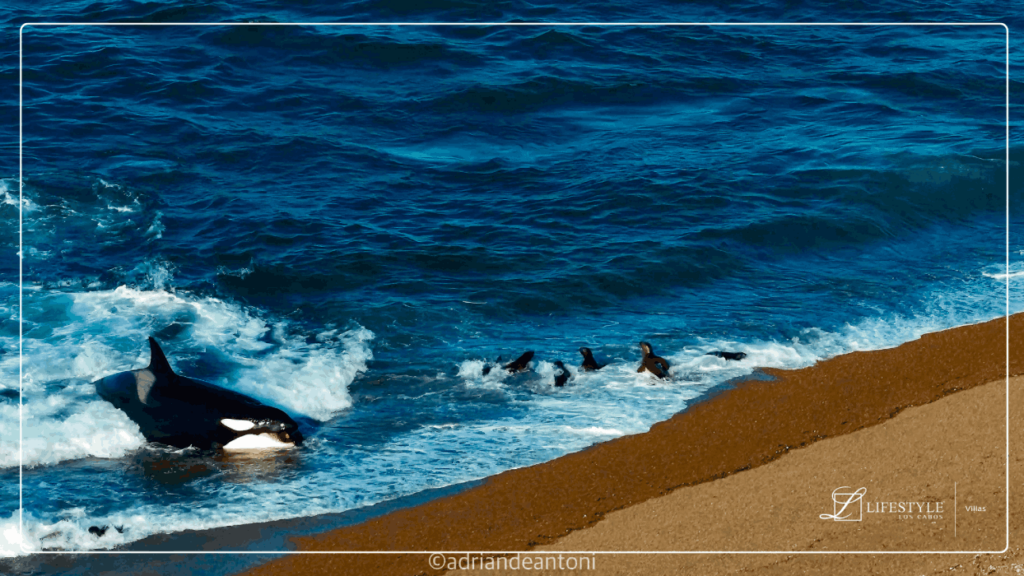
Orcas are considered the ocean’s apex predators, famous for their incredible intelligence, social behavior, and hunting strategies. They deserve special mention because, depending on their geographic location, they have developed different feeding techniques. One of the most well-known practices worldwide is the intentional beaching of sea lions, primarily to capture pups. This technique has been developed and perfected over generations, passed down through social learning.
This extraordinary behavior, which demonstrates the complexity of nature, has only been recorded in two regions of the world: Punta Norte, on the Valdés Peninsula, Chubut, Argentina, and the Crozet Islands, located in the Indian Ocean.
In Baja California Sur, swimming with these cetaceans is practiced, which implies a high degree of responsibility and respect for the animals. The risk lies not in humans being part of their diet, but in the potential negative interactions resulting from the irresponsible invasion of their natural habitat. Guests staying in Lifestyle villas within premium communities in Cabo San Lucas are increasingly seeking eco-conscious travel experiences that prioritize marine conservation and ethical wildlife observation. In our area, these practices are usually carried out under close supervision, something impossible in other areas such as those mentioned previously, since the hunting methods employed in those regions can be extremely dangerous to humans, making swimming with them strictly prohibited.
Therefore, promoting responsible and conscious tourism is essential to ensure the safety of people and the conservation of these incredible species, part of the natural heritage of the Sea of Cortez.
Visitors staying in Cabo San Lucas vacation villa rentals can also enjoy the incredible Whale Watching Season in Los Cabos, one of the most spectacular marine wildlife experiences in Baja California Sur. Many travelers choose Lifestyle villas located in exclusive communities in Cabo San Lucas to experience close encounters with whales, orcas, and other marine species while exploring the natural beauty of the Sea of Cortez. To make the experience even more comfortable and exclusive, many visitors also rely on Bespoke – luxury car service Cabo San Lucas for premium transportation throughout their stay in Baja California Sur.